Cisco · DevNet ecosystem
Envisioning a Marketplace for the Whole Ecosystem
A scenario-driven vision and Figma prototype for a marketplace serving service providers, customers and resellers — carried through executive review to sponsorship.
A note on what you're seeing. I take my clients' confidentiality seriously. The artifacts on this page are re-creations and abstractions of the real work, and the numbers are illustrative of project outcomes rather than audited figures. Happy to walk you through the genuine article — just ask.
The situation
An ecosystem is a set of people who need each other and can't find each other.
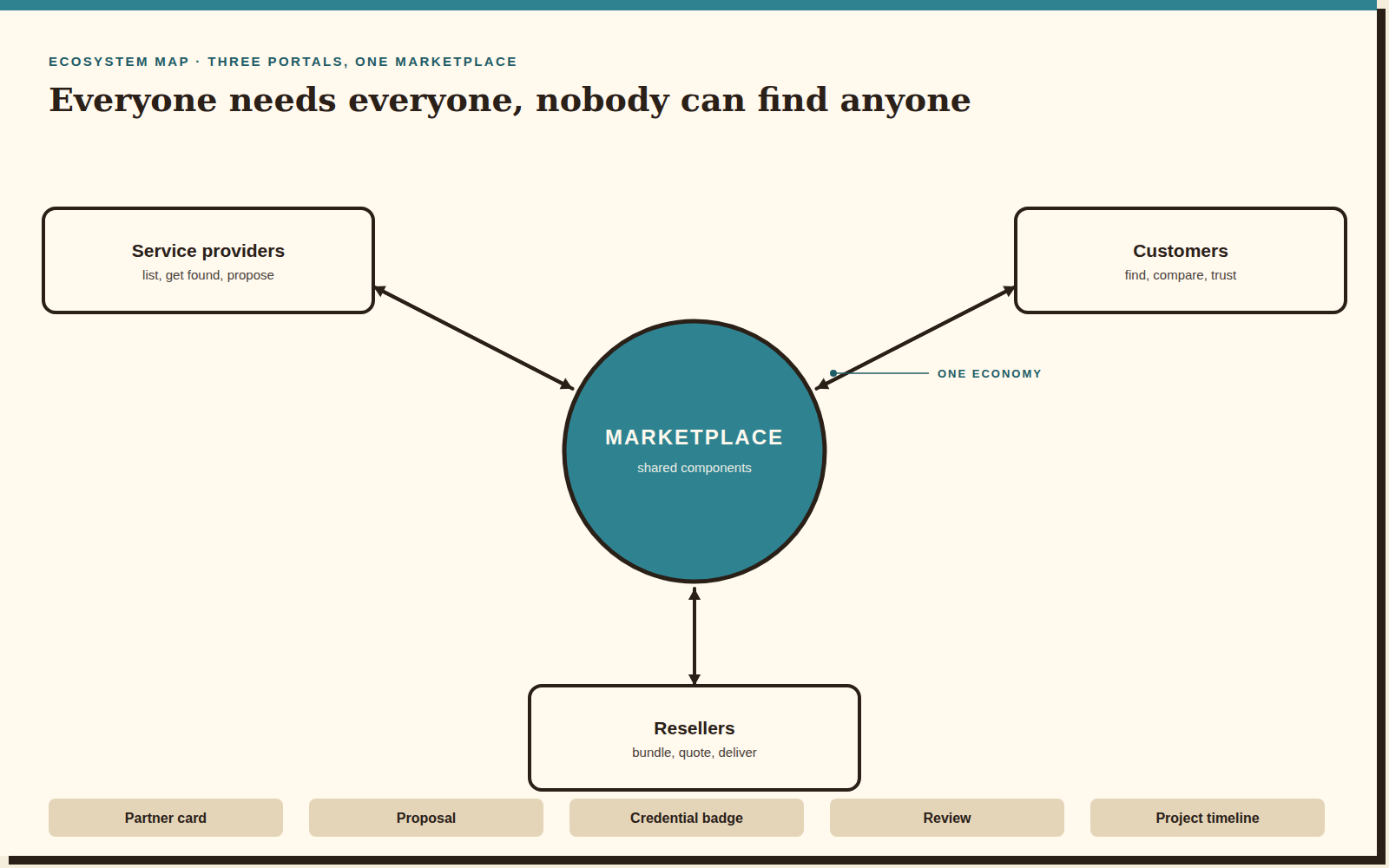
Cisco's partner economy — the service providers who build on its platforms, the customers who buy outcomes, and the resellers who bundle and deliver — ran through fragmented systems and a lot of email. Customers couldn't tell which partners were certified for what. Partners spent a serious share of their week on administration that a marketplace would absorb. Trust was the recurring blocker: verified credentials and real reviews, or nothing moves.
Business development had a hunch that a next-generation marketplace could change how the whole channel did business. A hunch doesn't get funded. My job was to turn it into something an executive could walk through.
My role
I was the UX designer on the envisioning effort, working with business development — building the personas, writing the scenario narratives, designing the multi-portal architecture, and producing the Figma prototype and the executive walkthrough that sold it.
The process
Beat one
Three personas, one economy
Service provider, customer, reseller: three personas with three vocabularies and one shared anxiety about trust. The insight that organised everything was that they are not three audiences for three products. They are three seats at one table, and the marketplace is the table.
Beat two
Scenario narratives
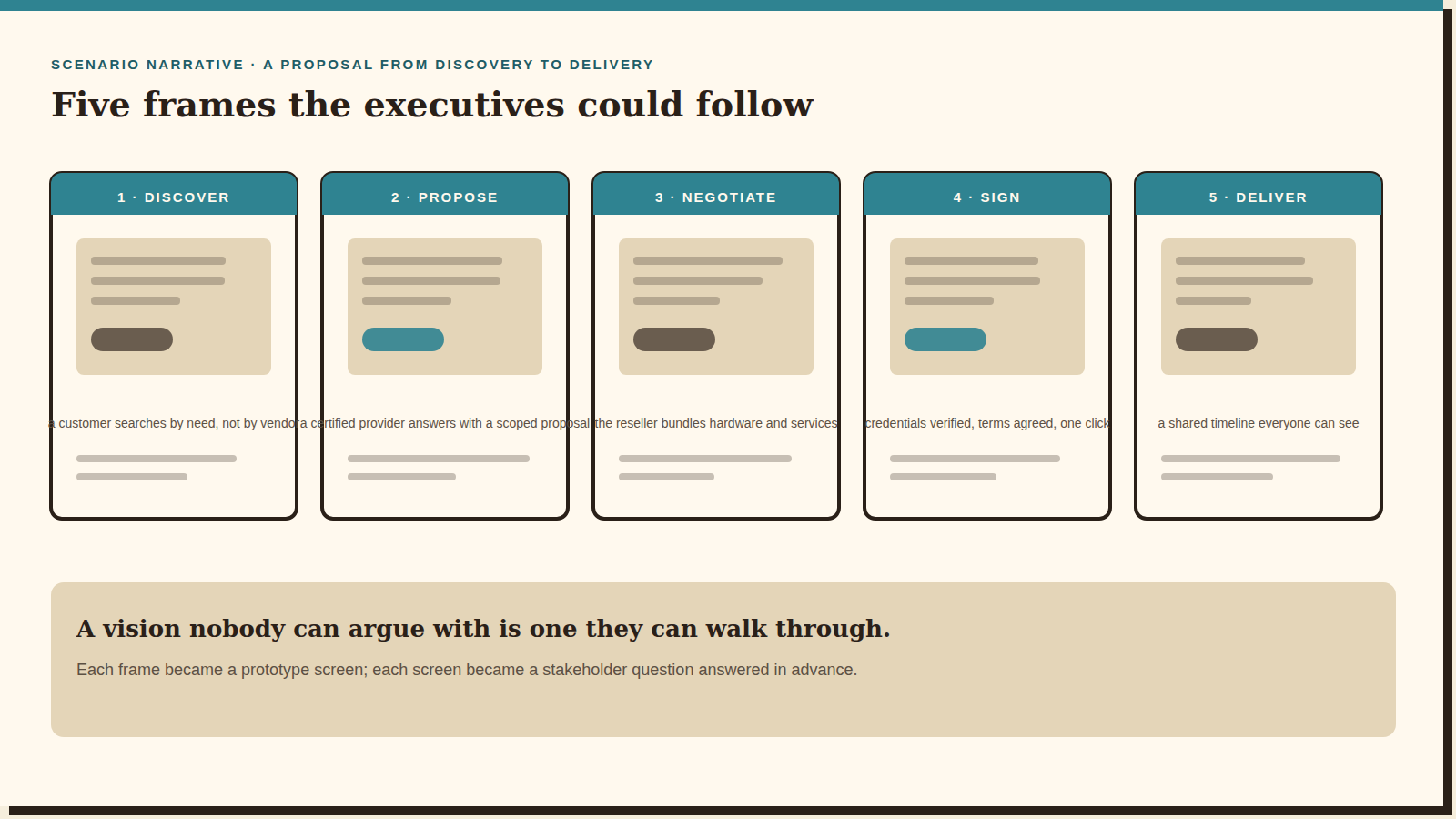
Rather than a feature list, five frames: a customer discovers, a provider proposes, a reseller bundles, everyone signs, everyone delivers on a shared timeline. Each frame became a prototype screen, and each screen answered a stakeholder question before it was asked. Narrative is how I make a vision un-arguable.
Beat three
Multi-portal architecture, shared parts
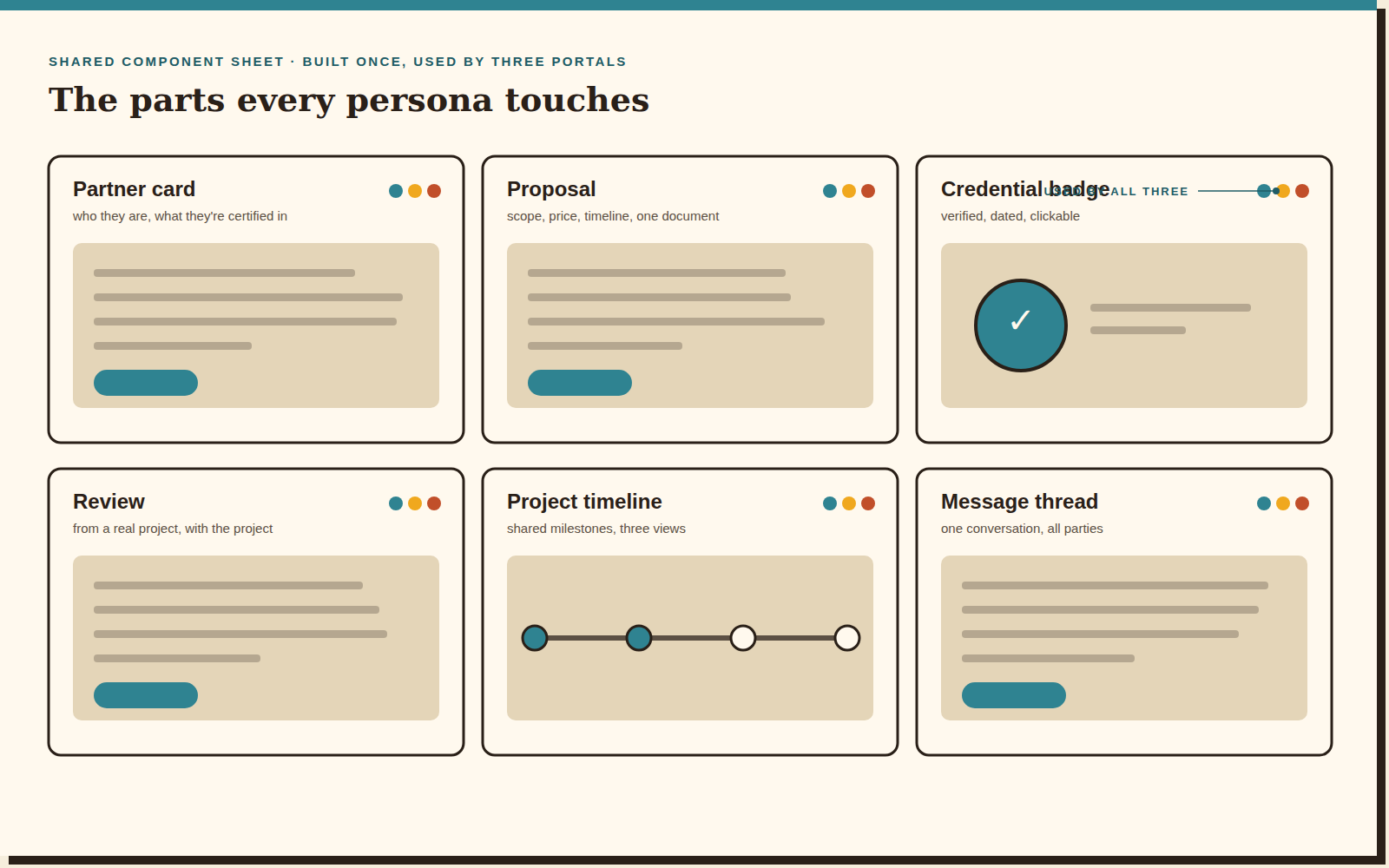
Three tailored portals over one component set: partner card, proposal, credential badge, review, project timeline, message thread. Built once, used by all three personas, styled per portal. That decision is what made the prototype extensive instead of merely wide — and it is the decision engineering thanked us for.
Beat four
The executive walkthrough
A scripted walk through the prototype as the five-frame story, presented to the sponsoring executives. Not a demo of screens — a demonstration that the ecosystem could work. It was sponsored. The prototype became the reference for the build teams that followed.
3 portals*
The outcome
Three persona portals on one shared marketplace, a full Figma prototype covering discovery, proposals and relationship management, and an executive presentation that turned a business-development hunch into a sponsored programme. Eleven months from “what if” to “go”.
Reflection
“A vision nobody can argue with is one they can walk through.”
Envisioning work is judged on whether it gets built, and most of it doesn't — not because the ideas are wrong but because the story never reaches the people who fund things. What I'd do differently: write the five frames in week two and let them be wrong in public, rather than polishing personas for a month first. The personas got better once the story existed to test them against.